Monthly Archives: May 2008

Six Million…

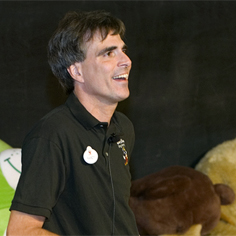
seems an impressive figure (about 2% of the U.S. adult population), but Randy Pausch, the 47-year-old Carnegie-Mellon professor who is dying of pancreatic cancer, deserves a bigger audience for his Last Lecture, created as a legacy for his young children. So, we’re doing our bit to get more people to tune in. (Here’s Randy’s website that contains all the links to his various appearances, and translations in Chinese (yes!).

Published in April, The Last Lecture is #3 on Amazon and prominently displayed at airport book stores (I saw it in Chicago and Denver last week). Co-author Jeffrey Zaslow’s report in the Encore section of the Wall Street Journal is a fine preview. This is the Tuesdays with Morrie of this decade, and its success is evidence that many of us are eager to read messages about making the most of every moment of life, from someone on the verge of losing it all. The important question is: what do we do next?

Update: Randy Pausch died July 25, 2008.  Here is more about his life.

God’s Waiting Room

Last week, as I visited my mother (91 in June) in a nursing home in Western Canada, the reality of what lies ahead for our elders and perhaps for ourselves was so in-my-face, I found myself hyperventilating (yoga training notwithstanding) and struggling to keep my spirits up, for her sake and mine.

In truth, I have a lot to be grateful for. My mom’s facility is as good as it gets: dedicated, kindly staff (if too few of them in oil boomtown Edmonton); clean, comfortable, well-equipped rooms; carefully calibrated meds for pain and depression; and lots of what we used to call extracurricular activities to help residents be more independent and social. Today, for example, a neighboring animal shelter had brought in puppies for petting. Sometimes, it’s nursery school children who are wonderful with old and disabled people. Last week while I was there, they had pub night when residents enjoy some wine and live entertainment.

When it was clear that my mother’s medical needs had become beyond our ability to provide for (geography didn’t help much), we choose this place also for the mix of age groups and levels of disability. So, my mom can socialize with a lovely 50-something woman named Sherry who suffers from MS, but who is also bright, friendly and also interested in jewelry and clothes. There are residents who play Scrabble and cards. And recently, a beautiful nurse-trainee from Brazil in body-hugging uniform, with fashionable haircut and great personality, was assigned there for a few weeks, and everyone perked up. All this costs about $30K/year, or less than half for a comparable facility here in Florida, and some of the expenses are tax-deductible.

But most of the population there are elderly so you can’t fight the God’s Waiting Room atmosphere, and I’m no better at staring that in the eye than the next person. So I spend most of my time amusing my mom: she adores Scrabble and Rummy 500, pizza and sushi, and a new brightly-colored dress. I can focus on these things because she already has her so-called affairs in order: personal directive and living will are all set; she gave me power of attorney a couple of years ago. I know what she wants for final ceremony and exactly where she wants her ashes strewn. Sure, she would rather be traveling to visit her great-grandchildren and spending the winter where it’s warm. But she has found a was to be happy in the moment. If you think about it, that is all we really have.

Being Downsized

Last week, a young friend got the ax. She was one of 8,000 people downsized by a large investment bank with reported losses of $10 billion in the first quarter. If that figure boggles the mind, it’s only because few of us can conceive of it in any real terms. How many tall skinny lattes would $10B buy? How much human misery does downsizing cause?

It didn’t matter that she had been at this firm for 10 years and had been assured when the last round of layoffs occurred that she ‘had nothing to worry about.’ She is single and turns 40 next March, so time is certainly on her side. Also, she has credentials in another , completely different field that could soften the loss of income. But that will take time to develop, just as it will take time to recover from the blow.

At first, she was more upset about the way it happened than that it happened. If you’ve been downsized, you recognize the circumstances. You are called in, given the news, and never return to your desk. Your things are mailed to you. If you are lucky, you will get assigned to an outplacement firm which helps you sort out COBRA, severance (if any) and so on. Sometimes, you get some career counseling. But it’s all pretty cut and dried. For the pain of separation, you’ll have to look elsewhere.

In some ways, the abrupt nature of downsizing is like retirement, even when it is voluntary. Endings are wrenching, especially if you’ve been with an organization for any length of time. You grow accustomed to health care coverage, colleagues and familiar faces, work you know how to do, perhaps even enjoyed, a sense that you are needed. Suddenly, THEY don’t want you any more. How do you not take it personally?

These days, people change jobs frequently and downsizing is so much a fact of corporate life, that your resume will not be blighted by this event. And, as we all know, retirement is not irrevocable. But even the most self-confident among us needs some time to process the separation, to let the shock subside, and even to grieve, if that feels right. If there’s no financial pressure to find another position, it could be an ideal time for a sabbatical.

Unless you are in academia, chances are an opportunity to take a break won’t come around again. Why not take advantage of the breathing room, the time to think and reflect? Perhaps you will find yourself asking Big Questions, like: What am I here for? What can I do to improve my community, society, the world? What kind of impact am I making in the larger sense? And if money were no object, what kind of work would I be doing? Such a shift in perspective could be just what you needed, and never had time for.
One Thing Leads to Another

I was walking with my friend and yoga student, Mary, up from the beach after finishing a class and she said she had been thinking more about how one thing leads to another, and whether that might be a good topic for the Small Group Ministry at the Unitarian congregation we both belong to.

We agreed that it was. It was also too intriguing a statement not to pursue, so I asked her to describe what she meant. And she told me, in brief, how she found her life-long passion because when she graduated from college, she went out knocking on doors looking for a job and found herself at the Library of Congress where they were looking for someone to work with the blind. All she wanted was a job, and it turned out to be a job that led to other jobs, in Beirut where she later lived, and then in Geneva, one thing leading to another, and in the process she found the work she was meant to do.

Why does this resonate with me? 2young2retire, the mom-and-pop I founded with my husband, Howard, ten years ago, helps people at midlife and beyond transition from work they did for a living, to work they do for love (and sometimes for money). Our book (Too Young to Retire: 101 Ways to Start the Rest of Your Life) and course on which it is based, use provocative questions to get at what really matters to people, where they feel they could make a contribution — a different motivation from making the mortgage payment — and then how to proceed to find that next work. This work, usually found in one’s late 50’s or 60, has been called a Next Chapter, a Second Act, an Encore career, but what characterizes this new work is that it feels like a calling, something you simply cannot resist doing.

Transition is never easy because we tend to be creatures of habit. And it’s good to have a plan, a goal, a sense of direction. But perhaps we’ve not given enough weight to the value of just getting started, taking that first step, as Mary did long ago, and then simply letting one thing lead to another. Because it most certainly will.

They Flunked Retirement, and the World Will Be Better for It

What do John Kanzius and Dr. Jose Antonio Abreau have in common, beside being featured in two back-to-back good news segments on a recent 60 Minutes (April 13)? Although motivated by very different causes, both 60-somethings came out of retirement to make contributions to humanity that will be felt for generations, perhaps forever. Here are the summaries of their stories.

Unable to sleep one night during a recent bout of chemotherapy for leukemia, John Kanzius, a retired businessman and radio technician, had a brainstorm: was it possible that radio waves could kill cancer? Months of tinkering in his own garage and thousands of dollars of his own money later, he produced the Kanzius Machine which, combined with nano technology, zaps cancer cells in experimental animals, leaving healthy tissue intact.  Kanzius’ invention has been deemed promising enough to attract research funding.

El Sistema, founded by retired economist Dr. Jose Antonio Abreau in 1975, is rescuing hundreds of thousands of young Venezuelans from lives of poverty and neglect, by teaching them to play a musical instrument and introducing them into youth orchestras. The Simon Bolivar National Youth Orchestra, the flower of eL Sistema, now plays to packed concert halls around the world. Says Raphel Elster, one of the leaders, “We work hard. And they love it!”

Staying On the Job: Open Dialogue Needed

All research on older workers indicates that a significant number will choose to become free agents of one sort or another, some swelling the ranks of entrepreneurs 50 and older. But many who are retirement-eligible would prefer to remain in their jobs, renegotiating terms of employment with their current employers. Phased retirement and consulting gigs are among the many options most sought after, if employees could find a way to broach the subject without jeopardizing their positions.

As it happens, the more enlightened companies are willing to listen (see A Longer Goodbye). These employers know that talent shortages are not going away any time soon. This means they are much more amenable to new ideas on how to retain valuable employees of a certain age. Sounds like a win-win, provided there is frank and open dialogue on the subject.  And a new bill before Congress now will certainly add some fuel to the discussion.

Regardless of which side of this question you find yourself, check out the Retention Connection, a collection of thoughtful articles on the subject from The Herman Group, “futurists specializing in workforce and worplace trends.” While you’re at it, you could sign up for the free Herman Trend Alerts, which arrives in my emailbox every week. There’s invariably a tip I find useful.