Monthly Archives: July 2008

It’s the Money, Honey!

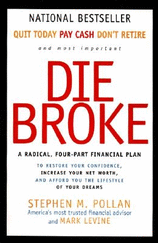
Some folks called it retirement savings. We prefer financial independence. What’s in a name? Well, which of those two terms give you a feeling of freedom, uplift and excitement about the rest of your life? Lots of ways to get that happy state, including voluntary belt-tightening when it doesn’t seem necessary, the millionaires’ secret to having and keeping wealth. Here are two mind-altering perspectives: Your Money or Your Life by Joe Dominquez and Vicki Robins and Die Broke: A Radical Four-Part Financial Plan by Stephen Pollan and Mark Levine.
Getting your financial house in order is also knowing where your money is coming from, and the chances are some of it will come from Social Security which you’ve been funding with your payroll taxes. Here’s a handy new calculator courtesy of your government, that will give you a base line of what you can expect, and a heads up if you are even contemplating quitting early. OK, Social Security may not cover all your anticipated expenses — although we know of an avid biker in Texas who manages to save enough from his Social Security payments to travel to Italy every year — but a monthly income you can count on, however modest it may seem, is a nice little cushion and a good place to start.

If some of the scary coverage about Social Security makes you wonder whether it will be there for you when you need it, read this earlier post.

Purpose-Driven Travel

If you’ve been there, done that, perhaps you are ready for a different kind of travel experience, one where you quit being a tourist and actually contribute something to the people and places you are visiting. Some folks have found an outlet lecturing and teaching on cruise ships in exchange for the voyage, which could be a good way to get your feet wet, so to speak. But if you think cultural immersion is more your speed, consider these examples.

Susan and David Cooper, 60-something world travelers, recently spent a week in Spain, helping a motivated group of business people hone their conversational English skills with Pueblo Ingles. One week of accommodations and food (both rated excellent) in exchange for their services; they paid their own airfare. Barcelona or Madrid, anyone?

Global Volunteers is an organization that puts the skills of experienced professionals to use in the developing world in what it calls a volunteer vacation abroad. Goals are similar to those of the Peace Corps: an interchange of ideas and cultures that enable volunteers and their hosts to learn from one another, but for shorter stays. World travel enthusiasts Herbert and Phyllis Goldberg are active Global Volunteers. Their first assignment took them to Vietnam for three weeks, where they “taught conversational English, advised in the hospital and medical clinics (Herb is a former plastic surgeon, Phyllis, a marriage and family therapist), taught medical and psychological policy and the American way of life.”

Your English language skills could also get you a job abroad for a longer period of time. The Oxford Seminars TESOL/TESL Teacher Training Certification Course offers a 60-hour in-class course. Graduates receive an internationally-recognized certificate and six months of free job placement assistance through its teacher placement department.

Where in the world would you like to teach? asks World Teach, a non-profit, non-governmental organization founded by a group of Harvard students in 1986. World Teach “provides opportunities for individuals to make a meaningful contribution to international education by living and working as volunteer teachers in developing countries.”

Bonding with Grandkids

We’ve had a special relationship with one of our grandsons since his birth when we lived a short bus and subway ride away and began to take care of him, one day a week. He is one of five grandchildren now, yet that early bond remains intact. When we have an opportunity to spend some time with this boy, we always seize it. So today, while his mother attended a business meeting, we picked him up from a swim class, and because it was a beautiful day in South Florida and we had a few hours, we decided to take him to a marine life center that opened last year.

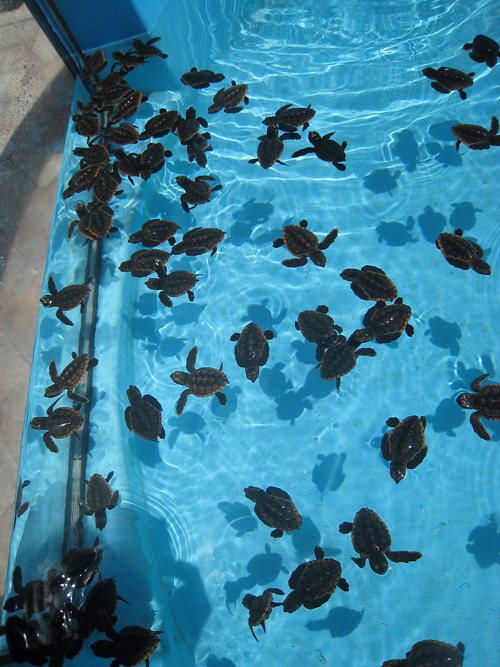
We live in an area where loggerhead and leatherback turtles lay their eggs in season, and most mornings when we walk on the beach, we can see their tracks as they crawl up the sand to deposit their eggs. By 9 or so, teams of volunteers have arrived to mark the nests so strollers don’t disturb the eggs. The center is devoted to rescuing hatchlings and nursing injured or sick turtles that get washed up on the beach back to health, so there were both species to see today, as well as tanks filled with sea anemones, fish and hermit crabs.

Today, we had a special treat because one of the teenage turtles was due to be released back into the ocean. There was a good crowd on the beach and a news crew had been alerted. Our grandson was completely captivated by what was unfolding, from the strapping of the turtle onto a gurney, to the wheeling of it down to the beach where a space had been cordoned off for the release itself. We were in the escort party. This female turtle, a volunteer informed us, would probably head right for the Gulf Stream where it has the best chance for survival. Years from now, it will return to the place where it hatched — perhaps even this very beach — and drop its own eggs, one of the great mysteries of navigation.

When the rescued turtle saw or perhaps smelled the water, it began to struggle a little against its restraining straps, and as soon as these were removed, flopped off the gurney and began to crawl toward the waves. A big wave washed over it then another and suddenly it was floating, swimming, and gone. Freedom! We all desire it for ourselves, for other creatures. The crowd cheered. The news cameras rolled. Some day in the future, the three of us will share the uplift of this indelible moment. A reminder of how good life is.

Good News Hunger

How often does a good news rise to the top of the list? Well, today it did in New York Times op-ed columnist Nicholas Kristof’s wonderful piece on Beatrice Biira, for whom the gift of a goat through Heifer International was the transforming event of her life. The fact that the column was #1 on the most emailed list was an indication of how much we hunger for good news in a time when it is in short supply. This is not only that rare occurrence, but a reminder of how relatively easy it is to make a huge difference in the life of someone who is heading into the oblivion of “one more illiterate African woman, another of the continent’s squandered human resources.”

At 2young2retire, we are often asked for ideas about community service by members of our 50 and older audience. The both good and bad news is: there are more social problems crying out for our help than there are people looking for them. Mature volunteers are in great demand for their life experience and dedication. Just look around your own community, look at the schools, see where and how the other half lives. And if you need a place to sift through the available volunteer opportunities, here are two. Idealist and Volunteer Match.

In the meantime, when you next need a gift for someone who has everything — and that is an awful lot of us in this country — consult the Heifer catalog. As little as $20 can send chicks to a family in Africa or Asia. You get a beautiful card to send to your friend or family member, along with your own message to appreciate the abundance in which many of us live by a happy accident of birth. Make you own good news; satisfy that hunger for uplift.

Much Ado About Retirement Savings

As if economic news wasn’t depressing enough, this week Hewitt Associates, “a global human resources consulting and outsourcing company,” got some press with a report that is sure to fuel money worries in all but the most financially secure Boomers-and-beyond. Quote: When factoring in inflation and increases in medical costs, Hewitt predicts that employees will need to replace, on average, 126 percent of their final pay at retirement—significantly more than the traditional targets of 70 to 90 percent pay replacement. Yikes!

But all is not lost, the report goes on to say. Small changes in behavior, e.g. increasing one’s savings, smarter investing, lower fees, and delaying retirement, can “enable more people to achieve a more comfortable standard of living once they retire.” The Motley Fool does the math differently, factoring out the ‘costs that evaporate once you leave the workforce’ — Retire Well for Less That You Think — to show that you need to replace much less income than is commonly supposed.

Both miss these points: 1. You can choose to reduce your standard living in any one of a number of ways, of which clipping coupons is the least creative and downsizing your living space perhaps the most disruptive, and 2. Opting to retire in the traditional sense will almost guarantee that you’ll be increasing your medical costs, so the choice to keep working in some capacity (pro bono, if you can and wish), actually positively impacts your bottom line.

For other fresh thinking and great tips you won’t find anywhere else, get yourself a copy of the new edition of Retire on Less Than You Think by Fred Brock, former Seniority columnist of The New York Times. Accessible as a Dummies book, it includes right-on personal anecdotes like how Brock cashed in a house in Montclair, NJ for a much less expensive one in Manhattan (Kansas, that is), and not only reduced his expenses but pocketed the difference.  By the way, he also ‘retired’ from Times job to become a journalism professor.  Read this review.