Category Archives: Thoughts on Retirement

Retiring Retirement

Retiring Retirement


Retiring retirement is an invitation to live and age more consciously—with presence, intention, curiosity, and vitality. For years, many of us followed the script: work hard, reach the finish line, then slip quietly into a new world of leisure. But conscious living asks a different questions: what if the finish line was never the point? What if the real joy begins when we stop performing the old retirement story and start aging more consciously?

Our limited liability company, 2Young2Retire®, was established 14 years ago when we took over the organization created by Howard Stone, co-author of Too Young to Retire. We’ve been championing the idea of retiring retirement ever since with the phrase Retiring the R Word. We may never eliminate the word, but we can certainly reshape the traditional retirement experience.

The meaning of retirement, as a word and a life stage, has evolved over time. Traditionally, it marked the conclusion of one’s primary career or long-term employment, usually marked by eligibility for government pensions or other retirement benefits. It’s the administrative milestone of leaving paid employment and stepping away from the workforce after decades of contribution.

This shift opens space for a reorientation of daily life, where structured hours give way to self-directed time—travel, volunteering, creativity, caregiving, rest, or simply living at a gentler pace. Retirement can also be a psychological and spiritual turning point, a moment to renegotiate identity, purpose, and meaning beyond professional roles. It invites the questions: Who am I being called to be? What am I being called to do?

We can’t eliminate the word retirement, but we can change our perspective. We see retirement as the conscious turning of energy from productivity to presence—a shift into a life shaped by intention rather than obligation. It’s a season to live more awake to our values, relationships, and life’s wisdom. In conscious aging, retirement becomes less an ending and more a transition into a new lifestyle.

Many people tell me they feel more alive once they retire—spacious, awake, more aware of the themselves, others, and the world around them. That’s not retirement. That’s renewal and revitalization.

Retiring retirement means releasing the idea that worth is tied to productivity or titles. It means letting go of the myth that our most meaningful contributions happen only in midlife. Conscious living reminds us that every season has its own calling. Some seasons build. Some tend. Some transform.

This shift isn’t about rejecting rest. It’s about reclaiming agency—choosing how we want to show up when external demands quieten down. Asking: What lights me up now? What conversations matter? What gifts can I offer, not because I have to, but because I want to?

My father retired after nearly 40 years with the electricity company. He was 58 years old and believed he’d live to three score years and ten, yet he lived 30 more years. He often said, “If I knew I’d live this long, I may have done things differently.” He did make significant contributions in the local community, serving on the school board and various committees and, despite being profoundly deaf, took up ballroom dancing with my mother, providing social connections that enriched and likely extended their lives.

Jan Hively, co-founder of the Pass It On Network with Moira Allen, had the mantra: “Work, paid or unpaid, until the last breath.” When we retire retirement, we shift our vision of life after paid work toward giving back and making a contribution. We stop seeing aging as narrowing and start seeing it as opening. We honor wisdom earned through experience, clarity shaped by perspective, and courage grown through seasons of living. We become elders in the best sense—guides, storytellers, and wisdom holders.

Conscious aging invites us to step into this chapter with intention and curiosity. To craft a life, not about stepping back, but stepping forward in a different way. Not retiring from life, but re-entering it with more presence, spaciousness, and wonder. Retire retirement. Claim renewal. Awaken to a new world with attention, intention, and positive action.

Contact Paul Ward here.

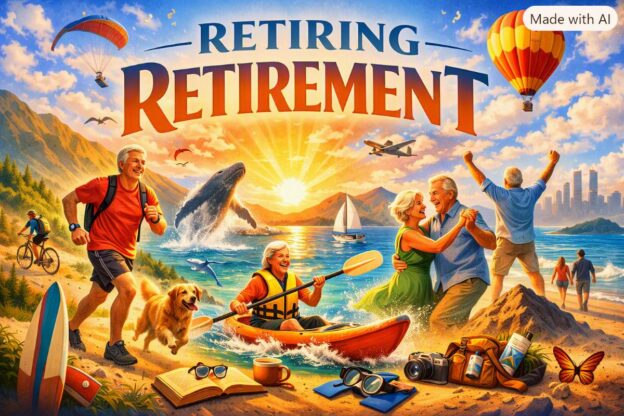
Image generated by Copilot.

Six Phases of Retirement

The six phases of retirement based on the original work of researcher Robert Atchley and described by Kenneth Shultz in his book, Happy Retirement: The Psychology of Reinvention, are: pre-retirement, retirement, disenchantment, reorientation, retirement routine, and termination of retirement. Although containing a lot of useful insights and presented in a colorful and imaginative style, Happy Retirement is not an easy read and these phases of retirement may be somewhat frightening to those who are already thinking they are Too Young to Retire®. 

Continue reading

Retire with Purpose Podcast

Retire With Purpose Podcast

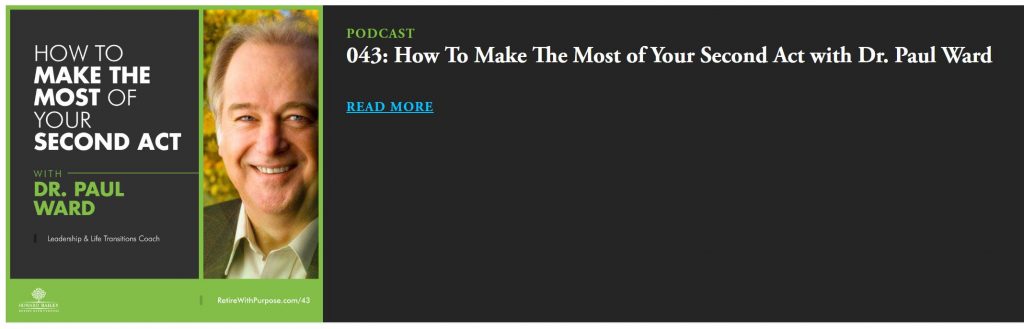
How to Make the Most of your Second Act

The Retire with Purpose Podcast is for anyone searching for the financial confidence to retire now or in the future – worry-free. I joined retirement expert, Casey Weade, for this podcast, How to Make the Most of your Second Act, sharing learnings from research studies on positive aging, guiding coaching clients through the process of envisioning a purposeful future, and introducing my recently published book, The Inner Journey to Conscious Leadership: Ten Practices for Leading Consciously.

To view the podcast, please visit Casey Weade’s Retire with Purpose webpage: https://retirewithpurpose.com/podcast/dr-paul-ward/

Daring to seek new opportunities

Entrepreneur and fitness expert, Betty Perkins-Carpenter, 85, has met life’s challenges with dedication, tenacity and persistence, which are hallmarks of conscious leaders. Here, she shares three tips to help others dare to seek new opportunities.

#1 Make a new beginning
At 72, I decided to go back to school and get my Ph.D. to continue my life’s work researching balance as part of my Senior Fitness business. In addition to research, my experience working with babies, preschoolers, elite Olympic athletes and seniors, on land and in water, led me to develop the Six-Step Balance SystemTM.

#2 Take chances and have fun
I started teaching swimming lessons in my backyard pool, which was risky. My business grew from taking chances and having fun. After 55 years in business, I still love getting up in the morning and helping people lead happier, healthier and active lives.

#3 Nothing is impossible
My veterans post commander gave me nearly 300 photos of soldiers taken at the beginning of the Korean War. I wanted to find these veterans and give photos to them or their families. In sharing my story, I found people willing to help. Because of their dedication and hard work, we created the Snapshots from the Korean War Project. Photos can be viewed at koreanwar.democratandchronicle.com.

Posted on behalf of Betty Perkins-Carpenter
by
Paul G. Ward
President, 2Young2Retire, LLC

No Fear Retirement

Although I believe that we are all still Too Young to Retire® I also know that there are many fears about the transitions from full time careers into new and uncertain phases of our lives. One of our 2Young2Retire® certified facilitators, Pamela Houghton, has published a new book, No Fear Retirement, written for anyone who is thinking about, or has already embarked upon, retirement.

No Fear Retirement addresses ten of the most common concerns of those who are thinking about retirement. Whether your fears are around finances, your relationships, where you will live, your identity, or something else, this book is a valuable resource. Taking time to reflect on the Pause for Thought questions along the twelve phases of retirement or associated with the ten most common fears, will make this read well worthwhile and may help you enjoy a more fun-filled and fulfilling life if or when you retire. For more information visit Pamela Houghton’s website: http://www.retirementsunlimited.co.uk/

Paul G. Ward
President

Retiring to something not from something

Our identity matters and, at 2Young2Retire®, we strongly advocate a forward looking approach to identity. Kim Potgieter, author of Retiremeant: Get More Meaning from your Money, in a recent interview by Dorian Mintzer, reminded us of the importance of retiring to something not from something. “I am a retired teacher” or “I am a retired salesperson” may reflect our past identity, what we have retired from. But what is your identity now? What are you becoming?

Thinking about being a former something, a former executive, a former teacher, represents the space between who we were and who we are yet to become. Consider the question, “Who do I want to be after this transition from a career just ending?” Here is an exercise that may help with looking forward: Take a sheet of paper and draw line down the center to create two columns. At the top of the left hand column, write ‘How I see myself now’ and at the top of the right hand column, write ‘How I would like to be.’ List your perceptions of yourself now in terms of areas such as ability, competence, relationships, income, roles, etc. Then write down who you would like be in the future. Consider who you are becoming; be purposeful; retire to something not from something.

Paul G. Ward
Principal

Retirement Transitions Requiring Exploration

I have to downsize my library. Two years ago, while moving from a house to an apartment, I reduced shelf space by fifty percent and now a new move is demanding another one third reduction. Many of these books are easily replaceable and I know about the value of letting go to create space for the new but I really struggle to let go of books in my collection. Many have special meaning because of relationship with the author or a period of my life which allowed a deep dive into an interesting topic. The books tell the story of my journey.

A friend of mine who is also experiencing significant downsizing is taking photographs before disposal not so much of books but of a wide variety of valued possessions. I love the idea although letting go of the physical may not create the space for the emotional or spiritual to come forth. Maybe it is more of exploration. Henry David Thoreau said, “An unexamined life is not worth living.” As we experience transitions before, during, and after retirement, and prepare to downsize and let go of our physical bookshelves, we can also examine our mental and emotional book shelves, and maybe let go of some things we have held onto for too long. I invite you to join me this week in examining what is really important in our lives and what we can let go.

Paul G. Ward
Principal

A Mindful Transition Pause

Wherever you are on your journey of transitions, I hope you will find time during this Thanksgiving week here in the US to take a mindful transition pause. Many of us are experiencing or anticipating transitions in our careers and in our lives. These transitions are rarely easy and we can easily fall into a period of depression where we feel disconnected from our past, dissatisfied with the present, and uncertain about our future.

To avoid the mindless transition pause where we feel lost between two worlds, letting go of our past identity without knowing our true identity, or unable to replace the job we recently lost, it is time to become more focused, more intentional, and more purposeful about the future. A mindful transition pause is a time of reflection, letting go of the past to allow space for the future to emerge, a place for you to simply be, in preparation for what is to come. An excellent place to start this mindful transition pause is in the place of gratitude. Expressing gratitude for the past and for the present creates the space for a more conscious, purposeful, and fulfilling future.

My thanks to Madisyn Taylor for introducing me to the mindful transition pause in her inspirational daily OM (http://bit.ly/I2bwpN). Continuing in the spirit of gratefulness, thank you for reading this blog and thank you for your emails and calls. These connections help us at 2Young2Retire to help you, wherever you are on your journey.

I will end this post with a Quero Apache Prayer: “Looking behind I am filled with gratitude. Looking forward I am filled with vision. Looking upwards I am filled with strength. Looking within I discover peace.” I wish you a mindful, purposeful, and happy Thanksgiving!

The Striking French

Driving to the first of two yoga teaching gigs yesterday, I listened to a report on NPR that Paris was all but shut down by unions striking against the proposed rise of retirement age from — get this — 60 to 62.   Flights were disrupted and even the Eiffel Tower was closed to tourists.  A few weeks ago, when the movement (if one can call it that) for status quo was just heating up, I heard a couple who had just turned 60, offer an argument you won’t hear on this side of the Atlantic so much these days, that they some how deserve to retire.  They felt they had paid into the pension funds and were fortunate that their pensions would not be threatened by the new law, if indeed it is passed.  In the background, one could hear the voices of their grandchildren for whom they offer care one afternoon a week because they enjoy it.

Contrast this to the desire of most Americans — I’m one of them –to continue to work and not only out of financial necessity, although that is certainly a factor given the sorry rate of saving and investments of many older adults.  The new MetLife Mature Market Institute Study finds “startling” the news that many Early Boomers plan to remain in the labor market.  But if you’ve been following this blog for any length of time, you know that we believe that money is not the only driver for the choice to continue to work.  We happen to think we will remain healthier for it — that alone is a good way to give back.  And unlike our French cohorts, we take a certain pride in continuing to contribute actively to society and to the well-being of future generations, including our own grandchildren, if we have them.   I admire many things about French culture — the food, the art, the joie de vivre, and the fact that the welfare of children is a national priority.  How they will reconcile childcare costs with an aging population that wants to be supported for 25 or more years is the question.  Send in the grownups.

Generational Warfare

How Might I/We?

Sounds like a question, but actually it’s much more. These three little words suggest that there is always an answer even if it is not immediately apparent. In fact, how-might-I/we? encourages us to dig a little deeper and get beneath our preconceived notions and cultural conditioning. It’s a radical, mind-opening approach that costs nothing and can lead to big breakthroughs.

We first encountered this model at a day long session at IDEO, a Palo Alto design firm and innovation generator, courtesy of the Purpose Prize summit. Here’s a quote from IDEO’s thinking on community that gives you an idea of what they are about: We believe that the power of community is stronger than that of a single individual, organization, or brand. Beyond the physical, cognitive and emotional factors of design, we foremost consider the social factors, asking questions and evaluating answers: How might the user’s relationships influence or motivate behaviors? How might an experience be shared with others? What is the meaning of belonging, and of identity? What drives the feeling of membership or loyalty to a bigger cause or group?

A good place to apply the how-might-I/we question is to the time of life still (despite all the evidence to the contrary) known as retirement. Let’s assume, for the sake of discussion, that you won’t be following the beaten path of your parents’ generation into the ‘role-less role’ they took for granted. Lots of reasons why your future will follow a different model, and not having sufficient funds is just one of them. If you’ve been paying even casual attention to the longevity revolution, you sense that something big has changed.

Recently, we were at a retreat at Kripalu Center for Yoga and Health. Sitting around a picnic table were eight individuals ages mid-40 and up. Seven of us had parents in their late 80s or 90s; one had an 86 year old mother who kept a busy volunteer schedule in her community and had no intention of slowing down. Clearly, this woman wasn’t settling for any so called age-appropriate role.

Between midlife and truly old age (whatever that is) is a phase most life-cycle experts haven’t given as much attention to as they might (and will). So if you often feel that you are up a creek, one paddle short, you are not alone. You’ll be better off imagining what you want out of the next 20 or more years. Set yourself free from preconceived notions of what you ‘should’ be doing, and be guided by the possibilities of discovering something you really love, whether for a paycheck or the fulfillment of giving back in some way. Innovate. Use IDEO’s How might we/I question when you have an important decision to make. You may be pleasantly surprised at how you answer.